Cookies help us deliver our services. By using our services, you agree to our use of cookies. Learn more


Automatic Door Bottoms: How to Choose One and When a Door Sweep Is Better
- October 27, 2026

If a door sweep drags, wears quickly, or cannot seal the gap the way the opening needs, an automatic door bottom may be the better fit. The important part is knowing why you need one before you buy it. A surface-mounted unit, a mortised unit, and a fixed sweep can all solve different versions of the same bottom-of-door problem.
This article walks through the choice the way a commercial buyer or installer would: first understand how the hardware works, then look at the opening, take the right measurements, and match those conditions to a specific product. If the problem is broader than the bottom of the door, start with the DoorsForPros weatherstripping guide so you are solving the right gap first.
Related guide: Door Weatherstripping Types: A Practical Guide for Real Projects
What Is an Automatic Door Bottom?
|
Quick Answer: An automatic door bottom is a door-mounted seal that drops against the threshold or floor when the door closes and lifts back up when the door opens. Most models use a small plunger at the jamb to trigger the drop. Because the seal retracts while the door swings, it can close the bottom gap without the constant floor contact you get from many fixed sweeps. |
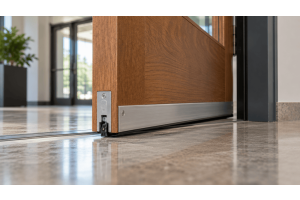
Think of it as a moving bottom seal. The metal housing stays on or inside the door, while the sealing bar moves only when the door reaches the frame. That makes an automatic door bottom different from a fixed door sweep, which stays in one position, and from a door shoe, which usually wraps around the bottom edge of the door.
A few terms are worth knowing. The undercut is simply the gap between the bottom of the closed door and the floor or threshold. The drop is how far the seal has to travel to close that gap. Handing refers to the direction the door swings and which side the hinges are on; some product series care about handing and others do not.

If you're looking to improve sound control at the bottom of a door, the Pemko STC411APK Acoustic Automatic Door Bottom is one option to consider. Before ordering, confirm the door width, mounting requirements, available clearance, and compatibility with the existing door and threshold.
Pemko STC411APK Acoustic Automatic Door Bottom View Product →
How Does an Automatic Door Bottom Work?
Most automatic door bottoms use a plunger that contacts the jamb. As the door reaches the end of its closing swing, the plunger contacts the frame and triggers the internal mechanism. The seal drops to the floor or threshold. When the door opens, the mechanism releases and the seal retracts into the housing.
-
The door swings toward the frame.
-
The plunger contacts the jamb near the end of the closing cycle.
-
The internal drop bar lowers the seal.
-
The seal meets the threshold or floor when the door is closed.
-
The seal retracts as the door opens again.
That retracting motion is the main reason buyers look at this hardware. The seal can work at the closed door without scraping across the floor for the entire swing. Adjustment is still model-specific, so the installation instructions for the exact product control the final setup.
Automatic Door Bottom vs. Door Sweep: What Is the Difference?
Both products deal with the gap under a door, but they do it differently. An automatic door bottom moves. A fixed sweep does not. That one difference affects floor contact, installation, adjustment, and the kind of opening each product suits best.
|
Decision point |
Automatic door bottom |
Fixed door sweep |
|
Seal movement |
Drops when the door closes and retracts when it opens. |
Stays in a fixed mounted position. |
|
Floor contact |
Designed to contact the floor or threshold mainly when the door is closed. |
May stay against or close to the floor while the door moves, depending on sweep type and adjustment. |
|
Installation |
Needs careful sizing and adjustment; mortised models require door preparation. |
Usually simpler to retrofit, especially with surface-mounted sweeps. |
|
Common forms |
Surface-mounted, semi-mortise, and full mortise. |
Blade, brush, and door-shoe styles are common. |
|
What drives selection |
Undercut, drop, mounting style, door construction, handing where required, insert, and performance needs. |
Gap size, sweep height/material, threshold or floor condition, exposure, and mounting. |
If a fixed sweep is the better fit, use the Best Door Sweep for Exterior Doors (Commercial Guide) to compare common sweep styles.
For openings where the sweep and threshold have to work together, see Door Sweep and Threshold: How to Build a Reliable Bottom-of-Door Seal.
Which One Should You Choose?
Do not treat an automatic door bottom as an automatic upgrade. Start with the opening. If a fixed sweep can seal the gap without causing a problem, the simpler hardware may be all you need. If you need the seal to lift away while the door moves, or the existing door is already prepared for a compatible automatic bottom, the retracting style may make more sense.
|
Opening condition |
Usually worth considering |
Why |
|
You want the seal off the floor while the door swings. |
Automatic door bottom |
The seal retracts instead of staying against the floor during the swing. |
|
You need a simple surface-mounted retrofit, and a fixed seal can cover the gap. |
Door sweep |
A sweep is often easier to install and service. |
|
The door already has compatible mortise preparation. |
Compatible mortised automatic door bottom |
Existing preparation may support a like-for-like replacement if the size and model match. |
|
The floor or threshold is uneven. |
Check the contact surface before choosing |
Insert type and surface condition can matter as much as the hardware family. |
|
The opening has fire, smoke, acoustic, or another performance requirement. |
A documented model for that opening |
The product name alone does not establish that it is suitable for the whole opening. |
|
Expert Opinion: |
What Types of Automatic Door Bottoms Are Available?
The main types are named for how the housing sits on or in the door. Mounting style is not just a cosmetic choice; it changes the door preparation, installation work, and the product families that will fit.
Surface-Mounted Automatic Door Bottom
A surface-mounted unit attaches to the face of the door, so the housing stays visible. It usually needs less door preparation than a full-mortise model, but you still have to check clearance, handing where required, fasteners, and the manufacturer's mounting details.

If you're looking for a surface-mounted automatic door bottom to help seal the gap beneath your door, the Pemko 412CRL is one option to consider. Before ordering, confirm the door width, mounting surface, required seal drop, and compatibility with the existing threshold and floor conditions.
Pemko 412CRL 36-inch Surface-Mounted Automatic Door Bottom View Product →
Semi-Mortise Automatic Door Bottom
A semi-mortise model is partly recessed into the door. It gives a lower-profile look than a full surface mount, but it still requires the correct door preparation for that product.
Full-Mortise Automatic Door Bottom
A full-mortise unit is recessed into the bottom of the door. The installation is more concealed, but door thickness, construction, end plates, and clearances all become part of the fit check.

If you're looking for an automatic door bottom to help seal the gap beneath your door, the Pemko 411ARL36 is one option to consider. Before ordering, confirm the door width, mounting requirements, available clearance, and compatibility with the existing threshold and floor conditions.
Pemko 411ARL36 Automatic Door Bottom View Product →
What Should You Measure Before Ordering?
Measure the real opening, not the nominal door size printed on a schedule. The goal is to know exactly what the seal has to span, how far it has to drop, and what surface it will land on.
|
Check |
What to record |
Why it matters |
|
Door/contact width |
Measure the width the unit actually needs to cover. Note jamb seals or gasketing at the sides. |
The order length can differ from the nominal door width. |
|
Undercut |
Measure the gap below the closed door at the intended contact surface. |
The gap tells you how much seal travel is required. |
|
Threshold or floor |
Note whether the seal lands on a threshold, smooth floor, carpet, stone, grout, or another surface. |
The contact surface affects sealing consistency and insert choice. |
|
Mounting condition |
Surface, semi-mortise, or full-mortise preparation. |
This quickly narrows the product families that will fit. |
|
Door construction and thickness |
Record material, thickness, and existing preparation. |
Some models have specific door requirements. |
|
Handing |
Record the door hand if the selected series is handed. |
A handed model must match the door. |
|
Project requirements |
Fire, smoke, acoustic, accessibility, or other specified needs. |
The exact model and complete opening need to meet the project requirements. |
If you are replacing an existing unit, photograph the old product and record any model number before removing it. That information can save more time than a tape measure alone.
How Do You Match the Measurements to the Right Product?
Once you have the opening measurements, match them to the actual product data. Do not shop by model name alone. Two automatic door bottoms from the same manufacturer can use different mounting styles, handing, door requirements, and field-trimming rules.
|
DFP product example |
What the manufacturer documents |
What it means for the buyer |
|
Pemko 412 Series |
Surface mounted; handed; up to 3/4 in. sealable gap; 1/2 in. recommended gap; stock units can be field-trimmed by up to 2 in. |
Check door hand, gap, order length, insert, and trimming before you buy. |
|
Pemko 411 Series |
Full mortise; non-handed; compatible with specified 1-3/4 in. and 1-3/8 in. door conditions; up to 3/4 in. sealable gap; stock units can be field-trimmed by up to 2 in. |
A concealed installation adds door-prep and thickness checks even when the sealing goal is similar. |
Compare DFP options: Pemko acoustic automatic door bottom selection
Do not carry one model's drop or trimming limit over to another product. Use the current cut sheet for the exact unit you are ordering.
Common Ordering Mistakes
Ordering from nominal door width alone. Jamb seals, clearance, and the manufacturer's sizing method can change the final order length.
Assuming every automatic door bottom has the same drop. Maximum drop and recommended working range vary by series.
Ignoring the threshold or floor. The seal has to land on a real surface. Carpet, grout, stone, and uneven thresholds can change performance.
Choosing the product before checking the mounting style. Surface, semi-mortise, and full-mortise units need different door conditions.
Assuming every model can be cut the same amount. Field-trimming rules are product-specific.
Treating fire, smoke, or acoustic ratings as a universal rating. The exact product and the complete opening still need to match the project requirement.
Automatic Door Bottom Checklist
-
Measure the actual contact width the selected product will span.
-
Measure the undercut with the door closed.
-
Check the threshold or floor surface and whether it is level.
-
Identify the mounting style the door can accept.
-
Record door construction, thickness, and existing preparation.
-
Check handing if the product series is handed.
-
Confirm any fire, smoke, acoustic, accessibility, or other project requirements.
-
Check the exact model for order length, allowable drop, insert, and trimming limits.
|
Key Takeaways
|
Choose the Seal That Fits the Opening
Start with the door, the gap, and the surface the seal will meet. If a simple sweep handles the opening cleanly, use it. If the opening needs a retracting seal, choose an automatic door bottom that matches the door preparation and the measured gap.
Ready to narrow the options? Browse Pemko automatic door bottom products or compare the surface-mounted and full-mortise models below.
Frequently Asked Questions
How do I replace an existing automatic door bottom if I do not know the model?
Start by checking the existing unit for a manufacturer name, model number, or other markings. Record the mounting style, overall length, door thickness, undercut, and how the unit is installed. Photos of the door bottom, jamb, and removed unit can also help narrow the replacement. Do not assume that a similar-looking model will use the same preparation or dimensions.
Can I retrofit an automatic door bottom onto a door that currently has a sweep?
Possibly. A surface-mounted automatic door bottom may require less modification than a mortised model, but the door still needs enough clearance and a suitable mounting condition. Check the door construction, undercut, threshold or floor surface, handing where required, and the selected product’s installation requirements before converting from a sweep.
Can I replace a mortised automatic door bottom with a surface-mounted model?
In some cases, but it should not automatically be treated as a direct replacement. The existing mortise preparation, door condition, clearances, performance requirements, and appearance all need to be considered. A like-for-like replacement may be simpler when the existing mortise is still suitable for a compatible model.
What happens if the automatic door bottom does not drop far enough?
The seal may not make consistent contact with the floor or threshold, leaving part of the bottom gap open. Check the actual undercut against the allowable drop and recommended working range for the exact model. Adjustment may help within the manufacturer’s limits, but a unit should not be expected to compensate for a gap beyond its documented range.
Why is my automatic door bottom not sealing evenly across the doorway?
An uneven floor or threshold, incorrect adjustment, installation alignment, or an unsuitable insert can cause inconsistent contact. Check where the seal meets the surface across the full width of the opening rather than judging the gap at only one point.
Can an automatic door bottom work with an uneven threshold or floor?
It depends on how uneven the contact surface is and on the selected product. Automatic door bottoms still need a suitable surface to seal against. Measure the gap at multiple points and review the product’s drop and insert characteristics before assuming the unit can compensate for an irregular floor.
Does the threshold matter when choosing an automatic door bottom?
Yes. The seal has to land against the threshold or floor when the door closes, so its height, condition, surface, and position can affect performance. The automatic door bottom and threshold should be considered together when the goal is to create a consistent bottom-of-door seal.
How do I know whether I need a surface-mounted or mortised automatic door bottom?
Start with the existing door preparation. A surface-mounted unit attaches to the face of the door and generally requires less modification. A full-mortise unit is concealed inside the bottom of the door and requires compatible door thickness and preparation. If replacing existing hardware, matching the current mounting style can often simplify the project.
Can an automatic door bottom be adjusted after installation?
Many automatic door bottoms provide some adjustment to control when and how far the seal drops, but the method and available range are model-specific. Follow the installation instructions for the exact product rather than using adjustment to compensate for incorrect sizing or an unsuitable opening.
What information should I collect before ordering an automatic door bottom?
Record the actual door or contact width, undercut, threshold or floor condition, mounting style, door thickness and construction, handing where applicable, and any existing model information. Also identify any fire, smoke, acoustic, accessibility, or other project requirements that may affect product selection.

Share on Facebook

Share on X

Share on Pinterest
Recent Posts