Cookies help us deliver our services. By using our services, you agree to our use of cookies. Learn more


Classroom Security Locks: What Changes When Locking from Inside?
- October 26, 2026

A classroom lock can look completely ordinary from the hallway and still work very differently once someone turns a key from inside the room. That difference matters when a school is replacing hardware, because a standard classroom function and a classroom security function do not give staff the same control over the outside lever.
This guide focuses on that one question: what changes when authorized staff can secure the corridor-side lever from inside the classroom? We’ll also cover the details a facilities or procurement team should check before ordering a replacement. It is a hardware-function guide, not a one-size-fits-all school security or code recommendation.
What Is a Classroom Security Lock?
|
Quick Answer: A classroom security lock lets authorized staff secure the outside lever from inside the classroom, usually with a key, while the inside lever stays usable for exit. A traditional classroom lock normally changes the outside lever’s locked or unlocked state from the hallway side. Exact operation varies by lock family, so the manufacturer’s function description should always be checked before ordering. |
Think of “classroom security” as an operating function, not a complete type of door hardware. The lock might be cylindrical, mortise, or part of another commercial hardware system. What makes the classroom security function different is the room-side control of the exterior lever.
A cylindrical lock is the common commercial lock that fits through round bored holes in the door. A mortise lock uses a rectangular lock body set into a pocket in the door edge. Either platform can have different functions, so the words “classroom security” tell you how the lock is meant to operate, not how the door is prepared.
Classroom Lock vs. Classroom Security Lock: What’s the Difference?
The main difference is simple: who can change the outside lever from inside the room. A traditional classroom function is usually locked or unlocked from the corridor with a key. A classroom security function adds authorized key control from inside the room, so staff do not have to open the door and step into the hallway to secure the outside lever.
|
Question |
Traditional classroom function |
Classroom security function |
|
Can the outside lever be secured from inside? |
Typically no. The outside lever is controlled from the corridor side. |
Yes, on the keyed classroom-security functions discussed here. |
|
Does the inside lever still open the door? |
Yes. |
Yes, on the mechanical functions discussed here. |
|
Is there usually an inside key cylinder for this control? |
Typically no. |
Commonly yes. |
|
Can authorized users still enter from the hallway? |
Depends on the exact function. |
Often yes with the proper key, but the exact behavior is model-specific. |
|
Main replacement question |
Does the new lock match the existing classroom function and door prep? |
Does it match the required inside-locking operation, door prep, and key system? |
If the project is deciding between a storeroom function and a standard classroom function, see Storeroom Lock vs Classroom Lock: What’s the Difference? This guide stays focused on the inside-locking classroom-security function.
What Changes When the Door Is Locked From Inside?
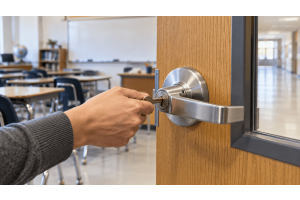
On a keyed classroom security function, the room-side key changes the state of the outside lever. The person inside can secure the corridor side without opening the door. The inside lever remains available to open the door from the room side on the mechanical functions covered here.
1. An authorized user inserts the correct key into the classroom-side cylinder.
2. Turning the key changes the state of the outside lever according to that lock function.
3. The corridor-side lever no longer provides normal entry while the function is secured, unless the model allows authorized key operation from outside.
4. The inside lever continues to retract the latch so occupants can leave the room.
That last point is important: the inside key cylinder controls entry from the corridor. It is not meant to turn the inside lever into a dead lever.

Can People Still Exit After the Door Is Secured?
Yes, on the mechanical classroom security functions used as examples in this guide, the inside lever remains operative after the outside lever is secured. In door-hardware language, that ability to leave is called egress. Put simply, someone inside can still turn the lever and exit.
That does not mean the words “classroom security” automatically make a particular opening compliant. The door, frame, latch, fire rating if applicable, accessibility requirements, and any access-control hardware still need to work together for the specific project and jurisdiction.
How Is This Different From Storeroom and Office Functions?
Commercial lock functions can look nearly identical on the door, so it helps to compare what the outside lever normally does and how someone inside the room can control it.
|
Function |
What happens on the outside |
Room-side control |
Inside exit |
|
Traditional classroom |
Authorized key use from the corridor controls whether the outside lever is locked or unlocked. |
Typically no inside locking control. |
Inside lever remains usable. |
|
Classroom security |
Authorized staff can secure the outside lever from inside. |
Yes, according to the exact function. |
Inside lever remains usable on the functions covered here. |
|
Storeroom |
Outside lever is normally locked; a key allows authorized entry. |
Not normally used to toggle the outside lever between locked and unlocked. |
Inside lever remains usable. |
|
Office/entrance |
Outside lever may be locked or unlocked by an inside button, turn, or other control, depending on the function. |
Yes, depending on the selected function. |
Inside lever normally remains usable. |
Why Lock Function Numbers Can Be Confusing
Hardware schedules often use ANSI function numbers as shorthand for how a lock operates. ANSI is the American National Standards Institute. The number can be useful, but it should not be the only thing used to select a replacement.

If you’re specifying or replacing a classroom lock, this Schlage ND Series option is one to consider. Before ordering, confirm the classroom function, lever style, core format, latch, strike, handing, and finish match the opening and the facility’s existing keying system.
Schlage Commercial ND70JDRHO626 ND Series Classroom Large Format Less Core View Product →
For example, Schlage lists its ND70 classroom cylindrical function as ANSI F84 and its ND78 classroom security cylindrical function as F110. SARGENT lists a 10XG16 classroom/security function as F88. The takeaway is not to memorize those numbers. It is to read the actual function description for the lock family you are buying.
|
Pro Tip: Do not order a classroom security lock from an ANSI function number alone. Match the lock type, manufacturer, inside and outside operation, key system, and existing door preparation. |
What Should a School Facilities Team Check Before Ordering?
Before you order a replacement, document the opening that is already there. A lock can have the right classroom-security function and still be the wrong part if the chassis, key system, door preparation, or other details do not match.
|
Check |
What to confirm |
Why it matters |
|
Lock type |
Cylindrical, mortise, exit-device trim, electrified hardware, or another platform. |
Different platforms use different door preparations and replacement families. |
|
Manufacturer and model |
Brand, series, model, and any visible function markings. |
This is the fastest route to a compatible replacement. |
|
Inside and outside operation |
Who needs to lock, unlock, or gain authorized access from each side. |
“Classroom security” is not identical across every product family. |
|
Key cylinder/core |
Conventional cylinder, SFIC/LFIC/FSIC where applicable, and keyway. |
The new hardware has to work with the school’s existing key system. |
|
Door prep |
Backset, door thickness, bored holes or mortise pocket, handing when applicable, and trim clearance. |
These details determine whether the lock physically fits. |
|
Fire rating |
Whether the opening has a fire label and what listed hardware is required. |
Changes to a rated opening may need additional review. |
|
Accessibility |
Lever operation and complete-opening requirements. |
Accessibility is checked at the opening level, not by the function name alone. |
|
Indicator |
Whether staff need a visible locked/unlocked status on the room side. |
Indicator options are model-specific. |
|
Access control |
Any wiring, electronic locking, monitoring, or centralized lockdown connection. |
A mechanical replacement may not be appropriate for an electrified opening. |
|
District standard |
Approved brands, lever styles, finishes, cores, and keying. |
Standardization makes maintenance and future replacement easier. |
Can a Classroom Security Lock Be a Direct Replacement?
Sometimes, but not automatically. If the replacement comes from the same lock family and is offered in the needed classroom-security function, the change may be straightforward. If the existing opening uses a different lock platform, door prep, key system, trim, or electronic hardware, more work may be required.
-
The existing lock is mortise, but the proposed replacement is cylindrical—or the other way around.
-
The backset or door preparation does not match the new lock family.
-
The school uses a specific interchangeable-core system or restricted keyway that is not offered in the proposed configuration.
-
The opening is tied into access control, monitoring, or a centralized lockdown system.
-
The door is fire-rated, and the proposed hardware or field modification needs listing review.
-
The opening uses exit-device hardware instead of a standard lever lock.
-
The district requires an inside status indicator that the proposed model does not offer.
The practical starting point is: identify what is on the door now, then match the required function. Do not start with a lever that looks similar and work backward.
How Should a Facilities Team Compare Models?
Compare the operation first, then the hardware details. The word “security” in a product name is not enough. A school should know exactly what the inside key does, what the outside key does, how people exit, and whether the lock fits the existing door and key system.
-
Lock platform: cylindrical, mortise, exit-device trim, or electrified hardware.
-
Manufacturer’s written classroom-security function description.
-
Inside-cylinder operation and how it changes the outside lever.
-
Outside-cylinder behavior while the outside lever is secured.
-
Inside lever operation for exit.
-
Cylinder/core and keyway options that match the district standard.
-
Indicator options, if the school wants visible locked/unlocked status.
-
Door prep, backset, thickness, handing where applicable, lever style, and finish.
-
Fire-label and project requirements where applicable.
-
Availability of replacement parts that fit the district’s maintenance plan.
DoorsForPros category: Commercial Leversets can be used to compare commercial lock families and available configurations.
Common Specification and Replacement Mistakes
Most mistakes happen when a team matches one detail and assumes the rest of the opening will follow. These are the checks worth slowing down for.
1. Treating “classroom” and “classroom security” as the same function
They are not. A standard classroom function usually relies on corridor-side key control. A classroom security function adds authorized control from inside the room.
2. Ordering from a function number without reading the operation
Use the manufacturer’s function description. The number is shorthand; the actual inside and outside behavior is what matters.
3. Forgetting the existing key system
A lock can fit the door and still be wrong for a school that uses a specific keyway, interchangeable-core format, master-key system, or restricted key system.
4. Looking only at the lever set
The door preparation, frame, fire label, access-control hardware, strike, and key system can all affect the replacement decision.
5. Assuming a similar-looking lock is a direct replacement
Commercial levers can look nearly identical while using different backsets, chassis, cylinders, functions, or door preparations.
6. Treating an inside key as the same thing as centralized lockdown
A mechanical classroom security lock gives local control at that opening. It is not the same as an electronic system that can lock or monitor multiple doors from a central location.
7. Making a nationwide code claim from the product name
Requirements vary by project and jurisdiction. The hardware should be reviewed against the project documents, adopted requirements, accessibility criteria, and the authority having jurisdiction.
Classroom Security Lock Review Checklist
Use this list before a school hardware order is released:
-
Existing lock type and manufacturer/model are documented.
-
Current function and required new function are confirmed.
-
Inside locking operation is clearly defined.
-
Authorized corridor-side access is clearly defined.
-
Inside lever operation for exit is confirmed.
-
Cylinder/core type and keyway are identified.
-
Door prep, backset, thickness, and handing, where applicable, are recorded.
-
Existing lever style, trim, and finish standards are recorded.
-
Indicator requirement is confirmed, if any.
-
Fire-rating/listing requirements are identified, if applicable.
-
Accessibility and complete-opening requirements are included in the project review.
-
Any access-control or centralized-lockdown coordination is identified.
-
District hardware and keying standards are checked before ordering.
Key Takeaways
|
If you remember only five things 1) A traditional classroom lock and a classroom security lock do not provide the same room-side control. 2) Classroom security functions let authorized staff secure the outside lever from inside while the inside lever remains usable on the mechanical functions discussed here. 3) “Classroom security” describes an operating function, not one universal lock model. 4) A correct replacement has to match the door prep, lock family, key/core system, and required inside/outside behavior. 5) The function name alone does not determine code, accessibility, fire-rating, or school-policy compliance. |
Frequently Asked Questions
How do I identify the classroom lock function already installed?
Start by identifying the manufacturer, lock series, and any visible model or function markings. Then check how the lock operates from both sides of the door: what the inside key does, what the outside key does, whether the outside lever stays locked or can be toggled, and whether the inside lever always allows exit. Do not identify the function from appearance alone, because similar-looking commercial locks can operate differently.
Can I keep the school’s existing key system when replacing a classroom security lock?
Possibly, but the replacement lock has to support the school’s existing cylinder, core, and keyway system. Before ordering, confirm whether the opening uses a conventional cylinder, interchangeable core, restricted keyway, master-key system, or another district-standard configuration.
Will a classroom security lock fit the same door preparation as the existing classroom lock?
Not automatically. Compatibility depends on the lock platform, backset, door thickness, bored-hole pattern or mortise pocket, handing where applicable, and trim clearance. A lock can provide the correct classroom-security function and still be physically incompatible with the existing door preparation.
What information should I collect before ordering a replacement classroom security lock?
Document the existing manufacturer and model, lock type, current inside and outside operation, cylinder or core type, keyway, door thickness, backset, door preparation, handing where applicable, trim and finish, fire label if present, and any access-control hardware. Photos of both sides of the door and the door edge can also help with identification.
What is the difference between cylindrical and mortise classroom security locks?
A cylindrical lock installs through bored holes in the door, while a mortise lock uses a larger rectangular lock body fitted into a pocket in the door edge. Both platforms can offer classroom-security functions, but they use different door preparations and replacement hardware. The required function should be matched to the lock platform already used at the opening.
Can classroom security locks use interchangeable cores?
Some commercial classroom-security lock families are available with interchangeable-core options, but availability depends on the manufacturer and series. If the school uses SFIC, LFIC, FSIC, or another interchangeable-core system, confirm that the selected lock supports the required core format and keyway before ordering.
Do classroom security locks have a locked or unlocked status indicator?
Some models offer indicators that show the room-side user whether the outside lever is secured. Indicator availability and appearance are model-specific, so this should be treated as a separate requirement when comparing lock families rather than assumed from the classroom-security function alone.
Can a classroom security lock be connected to an electronic lockdown or access-control system?
A standard mechanical classroom security lock provides local control at that individual opening. It is not the same as a centralized electronic lockdown system. If the existing door uses wiring, electrified locking, monitoring, or access control, the replacement needs to be reviewed as part of that complete system rather than treated as a simple mechanical lock swap.
How do I know whether a replacement classroom security lock will work with the existing strike and door?
Confirm the complete opening, not just the lever set. Check the door preparation, lock chassis, latch, backset, strike, frame condition, door thickness, handing where applicable, and any fire-rating or access-control requirements. A replacement that looks similar may still require different preparation or related hardware.
Are classroom security locks required by code?
Requirements depend on the jurisdiction, adopted codes and standards, project documents, district policies, and the authority having jurisdiction. The term “classroom security” describes a lock function and should not be treated by itself as proof that a particular opening meets all applicable egress, accessibility, fire-rating, or school-security requirements.
Plan the Replacement Around the Function
For a school hardware replacement, start with the door you already have. Record the lock family, inside and outside operation, door preparation, and key system. Then compare products that meet those requirements instead of choosing by appearance or by the words “classroom security” alone.

Share on Facebook

Share on X

Share on Pinterest
Recent Posts