Cookies help us deliver our services. By using our services, you agree to our use of cookies. Learn more


Government Building Door Hardware Guide: Public Facility Locks & Access Control
- September 24, 2026

|
Quick Answer: Government and public-building door hardware should be specified by security zone and opening type. A public entrance, service counter, staff office, records room, council chamber, stair door, loading entrance, and secure staff door do not need the same lock function or access-control strategy. The best specification balances public accessibility, free egress, staff security, restricted access, fire/life safety, durability, key control, and long-term maintenance. For federal facilities, accessibility can involve the Architectural Barriers Act (ABA); state and local government facilities are subject to ADA Title II requirements, in addition to applicable state/local codes and agency standards. |
For procurement teams, the goal is not to make every government door “high security.” It is to apply the right level of control to each opening while keeping public-facing doors usable, egress paths clear, and replacement parts consistent across the facility or agency portfolio.
DoorsForPros supports government procurement officers, facility managers, contractors,s and locksmiths with commercial hardware selection, bulk ordering, product configuration,n and nationwide fulfillment. Experienced hardware reps can help verify function, handing, finish, keying, door preparation, and component compatibility before an order is released.
Before You Specify: 10 Questions for Every Government Opening
1. Is the opening public-facing, staff-only, controlled, restricted, service, or egress?
2. Which entity owns/operates the facility — federal, state, county, municipal, or another public body — and what agency standards apply?
3. What door and frame are installed, and what hardware preparation already exists?
4. What security function is actually required: everyday locking, restricted keying, credential access, monitoring, lockdown, or another control?
5. Who must be able to unlock the door, and what emergency/responder access is required?
6. How much traffic, abuse, weather,r or cart/service impact will the opening see?
7. Is the opening fire-rated or part of a required means of egress?
8. Which accessibility framework applies — ADA Title II, ABA for applicable federal facilities, state/local code, or an agency-specific standard?
9. Does the facility need master keying, restricted keyways, interchangeable cores, credentials, or access-event logging?
10. Can the hardware be standardized across departments or sites to simplify spares, training, rekeying, and future procurement?
|
Procurement Advantage A security-zone and opening-type framework prevents both over-specification and under-specification. It also makes bids easier to compare because each hardware set is tied to a defined function instead of a vague “government grade” requirement. |
What Government Door Hardware Needs to Achieve
|
Priority |
Why It Matters in Public Buildings |
Typical Hardware Impact |
|
Public accessibility |
Residents and visitors must be able to use public-facing services and entrances |
Accessible hardware, correct door force/clearance, operators where selected, reliable public-hour operation |
|
Security zoning |
Not every area should have the same level of access |
Public, controlled, staff-only and restricted hardware sets with appropriate lock/access functions |
|
Key & credential control |
Lost keys or uncontrolled credentials create portfolio-wide exposure |
Restricted key systems, master key hierarchy, interchangeable cores or managed electronic credentials |
|
Durability |
Public buildings can have heavy daily traffic and long replacement cycles |
ANSI/BHMA-certified locks, hinges, closers and exit devices matched to use |
|
Fire & egress |
Security cannot interfere with required evacuation or rated-door performance |
Listed latching/closing hardware, approved locking arrangements, exit devices where required |
|
Auditability |
Some controlled areas benefit from knowing who accessed the opening and when |
Electronic access, door monitoring and logging where operationally required |
|
Maintainability |
Public agencies need predictable parts, repairs and replacement procedures |
Standardized product families, documented hardware sets and approved alternates |
|
Lifecycle value |
Public procurement often evaluates more than first cost |
Serviceability, cycle performance, spare parts, compatibility and consistent specification across sites |
Government Door Hardware by Area and Security Zone
The matrix below helps translate a public-building floor plan into door-hardware decisions. It is not a substitute for the project hardware schedule, agency security criteria, adopted code, or AHJ review.
|
Area / Opening |
What the Door Needs to Do |
Hardware Considerations |
|
Main public entrance |
Provide accessible public entry while supporting after-hours security |
Accessible operation; durable hinges/closer; automatic operator if selected; access control/intercom; weathering; egress |
|
Public lobby/service area |
Handle high traffic while separating public circulation from staff space |
Commercial levers/pulls, durable closer/hinges, controlled staff doors behind public zone |
|
Staff entrance |
Allow fast authorized entry without becoming an uncontrolled perimeter door |
Credential/key access, door-position monitoring where needed, heavy-duty closer/hinges, weather resistance |
|
Administrative office |
Provide everyday staff security with manageable keying |
Commercial cylindrical or mortise locks, master keying/interchangeable core, electronic access where appropriate |
|
Records/archives |
Restrict access and preserve defined accountability |
Restricted key/credential access, robust lockset, audit history if required, door monitoring where appropriate |
|
IT/server room |
Limit access to authorized technical personnel |
Credentialed or restricted mechanical access, robust lock, monitoring, environmental/door conditions |
|
Council chamber / public meeting room |
Support public use and safe high-occupancy egress |
Accessible hardware, heavy-duty hinges/closers, exit devices where required by occupancy/code |
|
Library/community room |
Handle high public traffic and scheduled after-hours use |
Durable commercial hardware, accessible operation, controlled staff/service rooms, exit hardware where required |
|
Stair/fire door |
Maintain rated-door and egress function |
Listed latching/closing hardware; exit/fire-exit device where required; no unauthorized auxiliary locking |
|
Loading/receiving entrance |
Withstand weather, deliveries and service traffic while limiting access |
Heavy-duty hinges/closer, robust lock/access control, protection hardware, threshold/weathersealing |
|
Public restroom/support space |
Provide accessible operation and appropriate privacy/control |
Accessible lever/pull, privacy function as applicable, staff/emergency access based on facility policy |
|
Restricted / high-security area |
Provide higher control based on agency risk assessment |
Project-specific high-security lock/access control, restricted credentials/keys, monitoring; coordinate specialty requirements with agency/security designer |
Separate Public Access From Staff and Restricted Access
Government buildings often fail when security is treated as one building-wide setting. Public entrances and service areas need predictable access during operating hours, while staff-only and restricted spaces need stronger control. A simple zoning model — public, controlled, staff-only, and restricted — makes it easier to choose the right lock or access method for each door.
The zone should determine the function. A public lobby door may prioritize accessible operation and scheduled locking; a records room may prioritize restricted access; a loading door may prioritize perimeter security and durability. Using the same lock function everywhere can make the building harder to operate without meaningfully improving security.
Public Entrances: Accessibility and Security Must Work Together
State and local government facilities are covered by ADA Title II, and new construction/alterations must follow the applicable ADA standards in addition to state and local requirements. For public-facing entrances, hardware should support accessible operation, required clearances,s and a predictable path into the facility while coordinating after-hours security.
Federal facilities designed, built, altered, ed or leased with federal funds can be subject to the Architectural Barriers Act (ABA) and the applicable agency’s ABA standards. Do not treat “government building” as one accessibility category; first identify which public entity and standard govern the project.
Related DoorsForPros guide: ADA Door Hardware Requirements: Complete Compliance Guide.
Exterior and Perimeter Door Hardware

Looking for the Standard Door Thickness 1.75" Tb Mezzotek-Necked Post Pull? View the product for full specifications, dimensions, finish, and hardware details.
Standard Door Thickness 1.75" Tb Mezzotek-Necked Post Pull View Product →
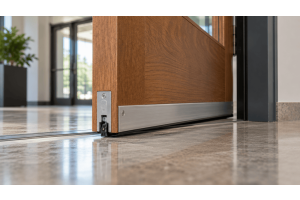
Government perimeter openings often combine public traffic, staff access, weather exposure, and a need for predictable lockdown or after-hours security. Select the lock, closer, hinges, threshold, weathersealing,g and any electronic access as a system. A high-security cylinder cannot compensate for a weak frame, worn hinge,ge or door that does not latch reliably.
Related DoorsForPros guide: Commercial Door Lock Types: Building Exterior Security.
Electronic Access Control, Monitoring and Audit Trails

Looking for the Schlage Electronic Standalone Keypad Programmable Electronic Lock? View the product for full specifications, configuration, finish, and access-control details.
Schlage Electronic Standalone Keypad Programmable Electronic Lock View Product →
Electronic access is useful where a facility needs credential-based entry, schedules, remote control, door-position monitoring, or event logs. It can be applied to staff entrances, records rooms, IT rooms, and other controlled zones without requiring every public door to become electronically locked.
An electronic lock alone does not create a complete audit trail. The reader, controller, credential platform, lock interface,e and software determine what is recorded, how long events are retained, ed and how permissions are changed. Define those requirements before selecting the locking device.
For large projects, see Best Electronic Door Locks for Large-Scale Projects.
Browse Commercial Electronic Access Hardware.
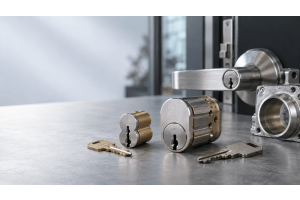
Master Keying, Restricted Keyways and Interchangeable Cores
Government facilities often need layered mechanical access: building master, department-level access, maintenance access, and individual office or room keys. Design the key hierarchy before ordering cylinders so the facility does not create unnecessary master-key exposure.
Restricted keyways can reduce unauthorized duplication, while interchangeable-core systems can speed field changes when staff or department access changes. Both require documented key-control procedures. If a facility already has a key system, verify keyway/core compatibility before buying replacement locks.
Related DoorsForPros guide: Rekeying vs. Changing Locks: Commercial Security Guide.
Commercial Lock Functions for Government Offices and Restricted Rooms
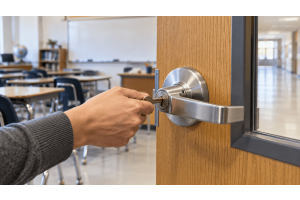
Lock function should follow the room. Administrative offices may use office/entry functions, storage rooms may use storeroom functions, public passage doors may need no locking at all, and access-controlled rooms may need electrified or credentialed hardware. Avoid specifying a deadbolt or high-security function simply because the building is government-owned.
Review common functions in the DoorsForPros Guide to Commercial Lock Functions.
For interior room types, see 6 Interior Door Lock Types: Match Security to Application.
Assembly and Public Meeting Spaces: Exit Hardware Where Required

Looking for the Accentra (Formerly Yale) 6000 Series Grade 1 Architectural Exit Device? View the product for full specifications, configurations, trim options, and hardware details.
Accentra (Formerly Yale) 6000 Series Grade 1 Architectural Exit Device View Product →
Council chambers, hearing rooms, community rooms, and other assembly spaces can have different egress requirements from offices. Panic or fire-exit hardware may be required based on occupancy, occupant load, door rating, and the adopted code. Verify the actual requirement before specifying an exit device.
Where exit hardware is required, choose the correct device type, trim, electrification,n and fire-exit listing. Do not add auxiliary locks that create an additional prohibited releasing step on the egress side.
Related DoorsForPros guide: Rim Exit Device vs. Panic Bar: Key Differences Explained.
Shop Commercial Exit Devices and Trim.
Door Closers and Hinges for High-Traffic Public Buildings

Looking for the Parallel Arm Super Smoothee Heavy Duty Adjustable 1-6 Surface Mounted Hold Open Cush Door Closer? View the product for full specifications, mounting details, adjustment range, and hardware information.
Parallel Arm Super Smoothee Heavy Duty Adjustable 1-6 Surface Mounted Hold Open Cush Door Closer View Product →
Main entrances, service doors, public corridors,s and meeting rooms can cycle heavily for years. Select hinges and closers for actual door size, weight, traffic, wind/pressure, and required closing/latching performance. A closer that is too strong can make a public door difficult to use; a worn hinge can prevent a secure door from latching even when the lock itself is functioning.
Use the DoorsForPros Door Closer Size Chart: How to Choose the Right Size for closer-sizing guidance.
Shop Commercial Door Closers.
Shop Commercial Door Hinges.
Fire-Rated Doors and Means of Egress
If a public-building opening is part of a fire-rated assembly, locks, latches, hinges, closers, exit devices,s and other hardware need to be permitted for the rated assembly and installed in accordance with the listing and applicable code. Security upgrades should never defeat the required closing, latching, ng or egress function.
NFPA 80 requires fire door assemblies to be inspected and tested after initial installation and at least annually thereafter. NFPA life-safety provisions also limit how doors in a means of egress may be locked. Coordinate special locking arrangements with the project design professional and AHJ rather than adding them as isolated security features.
ANSI/BHMA Grades and Lifecycle Performance
Government procurement often values lifecycle performance because hardware may remain in service for many years. ANSI/BHMA grades provide a tested way to compare performance, with Grade 1 representing the highest common grade level. But Grade 1 is not a complete specification: function, fire listing, accessibility, electrification,n and door preparation still have to match the opening.
For bored/cylindrical locks certified to ANSI/BHMA A156.2 and mortise locks certified to A156.13, Grade 1 products are tested through one million cycles under the respective standards’ durability requirements. That makes grade especially useful for high-cycle public and staff openings, but it should be applied where the opening needs the performance.
Related DoorsForPros resource: ANSI Lock Grades, Ratings and Security Requirements.
Older Government Buildings: Survey Before Replacing Hardware
Municipal and public buildings are often renovated in phases, which can leave several generations of locks, cylinders, hinges and closers in one facility. A replacement chosen from the visible trim alone may not match the door prep, backset, key system,m or fire-door requirements.
Before releasing a large order, survey representative openings. Record door thickness, handing, prep, lock function, keyway/core, finish, hinge type, closer mounting, fire label, and electrification. Test the proposed replacement on a small set of doors before standardizing it across the facility.
|
Retrofit Rule For a public project, low first cost can turn into high installed cost if every opening needs drilling, patching,g or frame modification. Compare product price together with retrofit labor, parts availability, and future maintenance. |
Standardize Across Departments and Sites — Without Over-Specifying
A practical agency standard can define repeatable sets for public entrances, staff entrances, offices, records/IT, service rooms, assembly exits, and stair/fire doors. Each set should document the approved lock function, series, finish, cylinder/core or credential method, closer/hinge requirements,s and acceptable alternates.
Standardization improves bid consistency and maintenance, but it should not force the highest-security hardware onto every office door. Use the standard to reduce unnecessary variation while preserving the opening-specific function.
Government Door Hardware Pre-Order Checklist
|
Check |
Confirm Before Ordering |
|
Facility/authority |
Federal, state, county, municipal or other entity; agency standards and procurement requirements |
|
Door & frame |
Material, thickness, size, handing, condition, and existing preparation |
|
Security zone |
Public, controlled, staff-only, restricted, service or egress |
|
Function |
Office/entry, storeroom, passage, access-controlled, high-security or another approved function |
|
Traffic/environment |
Cycle demand, public use, carts/service traffic, exterior weather and abuse |
|
Fire/egress |
Door/frame label, required latching/closing, exit-device requirement and special locking conditions |
|
Accessibility |
ADA Title II, ABA if applicable, state/local accessibility code and agency requirements |
|
Keying/credentials |
Keyway/core, master hierarchy, restricted keying, cards/keypads/mobile credentials and staff overrides |
|
Electrification |
Voltage, power transfer, reader/controller compatibility, monitoring, fire-alarm and power-loss behavior |
|
Lifecycle/parts |
Certified performance, service access, spares, warranty and approved alternates |
|
Quantity/standardization |
Approved sets by security zone, department, building and procurement phase |
|
Documentation |
Hardware schedule, manufacturer data, fire listings, submittals, agency/security approval and test-opening results |
Final Takeaway
Government door hardware works best when the building is divided into clear access zones, and each opening is specified for its real job. Public accessibility, staff security, restricted access, fire/life safety, durability, key control, and lifecycle maintenance all matter — but not at the same level on every door.
For procurement and facility teams, the most reliable process is to identify the governing agency and standards, document the opening, define the security zone and function, verify accessibility and fire/egress conditions, then standardize compatible hardware into repeatable sets. That creates a specification that is easier to bid, install, maintain, and expand across sites.
Need Help With A Government Or Public-Facility Hardware Project?
DoorsForPros helps contractors, facility managers, and procurement teams source commercial locks, leversets, closers, hinges, exit devices, electronic access, and related hardware for repeated openings and bulk projects. Talk to a hardware specialist if you need help matching function, handing, finish, keying, existing door preparation, or compatible components.
Frequently Asked Questions About Government Door Hardware
What door hardware is commonly used in government buildings?
Government buildings commonly use commercial leversets, cylindrical or mortise locks, door closers, hinges, exit devices where required, electronic access, and restricted key systems. The correct mix depends on whether the opening is public, staff-only, restricted, service,ce or egress.
Does every government door need a Grade 1 lock?
No. Grade 1 is appropriate for many high-cycle or demanding openings, but ownership by a government entity does not automatically make Grade 1 mandatory on every door. Use the project specification, required function, tested performance, fire rating, accessibility, and lifecycle needs to determine the right grade.
What is the best lock for a public-facing government office?
There is no single best lock. Public-facing offices usually need accessible operation during business hours, predictable after-hours security, and serviceable commercial hardware. The right lock function depends on the office workflow, door preparation, key/access system,m and security zone.
How should a government building separate public and staff access?
Define access zones first. Keep public circulation simple and accessible, then place controlled hardware at the doors that separate staff or restricted areas. This avoids over-locking public doors while still protecting sensitive spaces.
Can government facilities use electronic access control with audit trails?
Yes. Credential systems can provide schedules, remote control, door monitoring, ng and access-event logs. The complete reader/controller/software/lock system determines what is recorded; the lock alone does not guarantee an audit trail.
What access control is appropriate for records and IT rooms?
These rooms often need restricted mechanical keying or credentialed access, depending on agency policy and risk. If the facility needs accountability, add monitoring or event logging. The door/frame strength, egress, and fire-rating conditions still need to be checked.
What ADA requirements apply to state and local government door hardware?
State and local government facilities are covered by ADA Title II. New construction and alterations must follow the applicable ADA standards in addition to relevant state/local requirements. Door hardware, clearances, opening force, and controls may all be part of the accessibility review.
What accessibility standard applies to federal buildings?
The Architectural Barriers Act applies to many facilities designed, built, altered,d or leased with federal funds, with standards adopted by federal agencies. The specific project can also have agency and local requirements, so the procurement team should identify the governing standard before selecting hardware.
When is panic hardware required in a public building?
It depends on occupancy, occupant load, door rating, and adopted code. Assembly rooms and other high-occupancy spaces are common places where exit hardware may be required, but not every public-building exit needs a panic device.
How should government facilities manage master keys?
Define a key hierarchy, restricted keyway/core format, who can receive each key level, how lost keys are handled,d and how cylinders will be changed. Interchangeable cores can improve field service, but they still require formal key-control procedures.
What should be considered when replacing hardware in an older municipal building?
Survey existing doors before ordering. Record door thickness, handing, prep, lock function, keyway/core, finish, hinges, closer, fire label, and electrification. Test the replacement on representative openings before releasing a building-wide quantity.
What hardware is appropriate for a government loading or receiving door?
These openings usually need heavy-duty hinges/closers, robust locking or credential access, weathersealing,g and protection hardware. Door monitoring may be useful where receiving areas are not continuously staffed.
Can a government building use deadbolts for extra security?
Sometimes, on permitted non-egress or otherwise code-compliant openings. Do not add a deadbolt or secondary lock if it creates an extra prohibited releasing step on a required means-of-egress door or conflicts with a fire-rated assembly.
How should an agency standardize hardware across multiple sites?
Create repeatable sets by security zone and opening type, not one “government lock” for every door. Document the approved product family, function, grade, finish, key/core or credential method, accessories, es and acceptable alternates.
What should be included in a government door hardware procurement package?
Include the opening list, quantities, functions, door/frame preparation, handing, finishes, keying/core requirements, fire ratings, electrification, accessibility/security criteria, approved products/alternate,s and delivery phases. For renovations, include existing-model and field-survey data.
Can DoorsForPros support multi-site government projects?
DoorsForPros supports commercial project buyers with broad hardware selection, bulk ordering, nationwide shipping, and access to experienced hardware representatives. Multi-site buyers can standardize approved hardware sets and release quantities by building or project phase.

Share on Facebook

Share on X

Share on Pinterest
Recent Posts